Cleveland’s industrial expansion through the late 19th century left behind a complex patchwork of fill, natural lacustrine clays, and variable bedrock depths that still shape geotechnical decisions today. The city's proximity to Lake Erie means groundwater is often just a few feet below grade, complicating excavation and foundation design. For projects along the Cuyahoga River Valley or in downtown neighborhoods like Ohio City and Tremont, understanding the shear strength of these layered deposits is critical. A triaxial test provides the drained and undrained strength parameters that standard penetration blow counts alone cannot resolve. When weak, compressible layers underlie deeper footings, our team often recommends pairing triaxial data with in-situ permeability testing to assess consolidation rates under structural loads.
Effective stress parameters from a triaxial test tell you how the soil will behave after construction, not just during excavation.
Scope of work in Cleveland
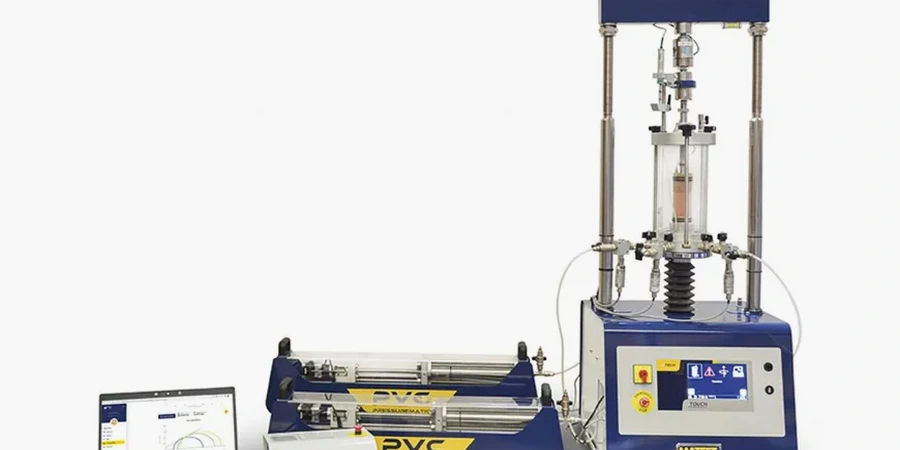
Demonstration video
Typical technical challenges in Cleveland
A mistake we have seen repeated too often on Cleveland job sites is designing retaining structures using only total stress parameters from unconfined compression tests on fat clays that are clearly subject to long-term pore pressure equalization. The IBC and ASCE 7 reference standards require effective stress analysis for permanent works in saturated fine-grained soils, yet some reports still omit the consolidated-undrained triaxial phase to save a few days of lab time. When a contractor proceeds with an under-designed excavation support system in the lacustrine plain, lateral movements during spring thaw can exceed serviceability limits and damage adjacent utilities. Ignoring sample disturbance effects or testing at a single confining pressure also masks the nonlinearity of the strength envelope, leading to unconservative bearing capacity calculations. A proper triaxial program, with careful specimen trimming and back-pressure saturation, eliminates these blind spots before the first bucket of earth is moved.
Our services
Our laboratory program in Cleveland adapts the triaxial configuration to the specific failure mechanism being evaluated, whether that is rapid loading during construction or long-term drained conditions after groundwater re-equilibration.
Consolidated-Undrained Triaxial with Pore Pressure Measurement
This test follows ASTM D4767 for saturated cohesive soils and measures both the total and effective stress strength envelopes. We saturate each specimen under back-pressure until the Skempton B-value exceeds 0.95, then shear at a rate slow enough to allow pore pressure equalization. The result is a reliable set of c' and φ' parameters for slope stability modeling and retaining wall design in the Cleveland lake plain.
Unconsolidated-Undrained Triaxial Testing
Performed per ASTM D2850, this procedure evaluates the undrained shear strength of cohesive soils under a range of confining pressures without allowing drainage or consolidation. It is particularly useful for assessing short-term bearing capacity of footings on the stiff glacial clays found beneath Cleveland's east side neighborhoods, where construction loading occurs faster than pore water can dissipate.
Quick answers
What sample quality is required for a reliable triaxial test on Cleveland clays?
Specimens must be trimmed from undisturbed Shelby tube samples that have been properly sealed and transported per ASTM D4220. The tube should be free of dents and the sample ends should not show signs of desiccation or disturbance. Our lab inspects every tube before extrusion and rejects material with visible cracks, gravel inclusions, or softening from poor field handling.
How long does a consolidated-undrained triaxial test take in the laboratory?
A complete CU triaxial suite with three confining pressures typically requires five to seven working days. Most of that time is spent on the saturation and consolidation phases, which cannot be accelerated without compromising the B-value check. The actual shearing stage runs over several hours per specimen depending on the consolidation coefficient of the soil.
What does a triaxial test cost for a Cleveland project?
A full triaxial program with three specimens, including consolidation and pore pressure measurement, generally falls between US$2,130 and US$2,980 depending on the number of confining pressures and whether effective stress parameters are required. The exact scope is defined after reviewing the boring logs and the design loading conditions.
Can triaxial test data be used directly in finite element models?
Yes, the stress-strain curves recorded during the shearing stage provide the backbone for hyperbolic and hardening-soil constitutive models. We export the digitized data in formats compatible with PLAXIS and FLAC, including the tangent modulus at 50% of peak deviator stress and the failure ratio, so that the numerical model captures the nonlinear response of Cleveland's stiff glacial tills.