Assuming uniform soil drainage beneath a site is one of the most expensive mistakes we see in Cleveland, especially when a dewatering plan is designed without real Lugeon or Lefranc values. The city sits on a complex glacial legacy—Lake Erie lakebed clays, silty tills, and the underlying Ohio Shale—where hydraulic conductivity can shift from 10⁻⁶ cm/s to 10⁻³ cm/s across a single block. In our experience, lab permeameters on small samples never capture the fractures in the shale or the sand lenses in the till. That is exactly why the field permeability test matters: it measures the mass response, including secondary porosity. For deep excavations near the Cuyahoga River or basements in the Flats, we often pair this with a grouting assessment because the variable water inflow directly controls the injection strategy and cutoff depth.
A single Lugeon stage in fractured Ohio Shale tells you more about real water inflow than twenty lab perm tests on intact core.
Scope of work in Cleveland
Typical technical challenges in Cleveland
The contrast between the eastern suburbs and the river valleys illustrates the risk perfectly. In Shaker Heights, dense glacial till often masks slow drainage, leading contractors to underestimate pit stability. Down in the Industrial Valley near the steel mills, fractured shale and slag fill create preferential flow paths that can flood an excavation in minutes. The real danger is applying a single regional permeability assumption to both. A Lugeon test in the valley might show a Lugeon value exceeding 50, while a Lefranc test in the till a few miles away barely registers 10⁻⁵ cm/s. Ignoring this variability leads to undersized pumps, slope washouts, and catastrophic base heave. We have seen projects delayed for months because the initial geotechnical report relied solely on grain-size correlations instead of direct in-situ measurement of the hydraulic conductivity field.
Our services
Our Cleveland field permeability program covers the full cycle, from packer placement to the final hydrogeologic report. We adapt the method to the local geology—Lugeon for the Ohio Shale and Chagrin Shale, Lefranc for the alluvial sands and silty tills. Every test includes barometric compensation and real-time digital logging to detect packer bypass or hydraulic fracturing immediately.
Multi-Stage Lugeon Testing
Focused on the fractured shale and siltstone formations across the Cleveland area. We use five pressure steps per stage to identify flow regimes (laminar, turbulent, dilation, or wash-out), providing the data needed for grouting cutoff design and deep excavation dewatering.
Lefranc & Variable Head Testing in Overburden
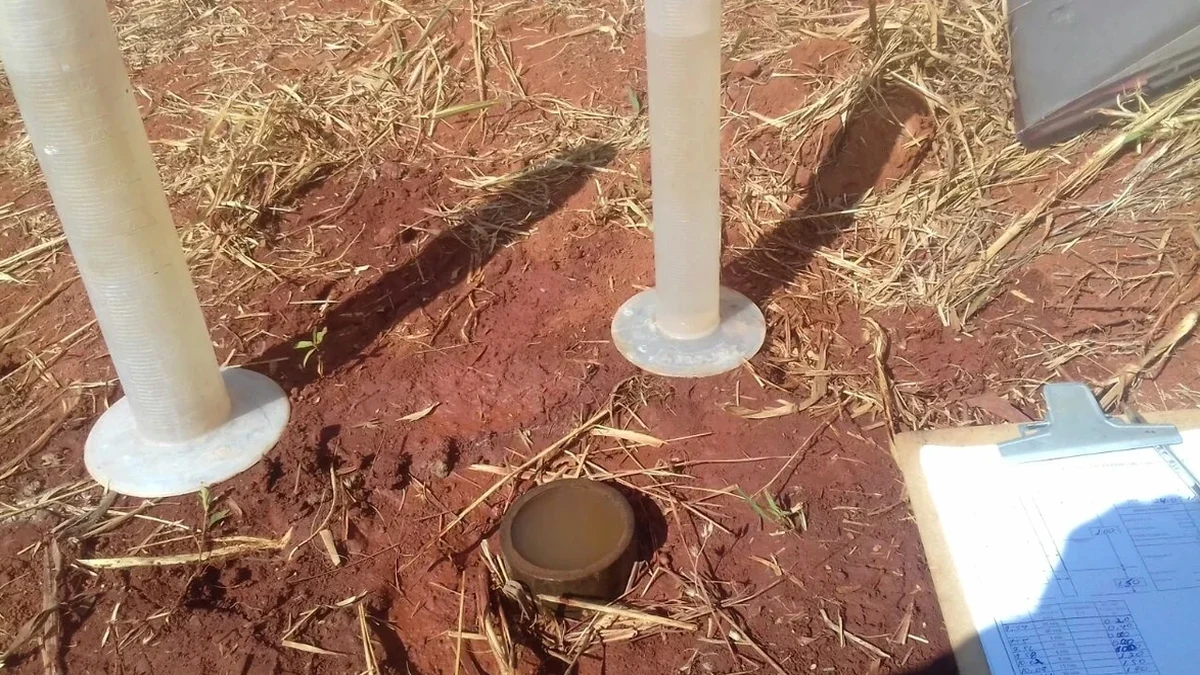
Designed for the glacial tills and alluvial deposits along the Cuyahoga River. We execute falling-head and constant-head tests in drill holes or test pits to determine the in-situ permeability of the soil matrix, essential for settlement rate calculations and temporary works design.
Quick answers
What is the difference between a Lugeon test and a Lefranc test?
The Lugeon test (ASTM D6391) is a constant-head injection test performed in borehole intervals isolated by packers, primarily for fractured rock masses like the Ohio Shale found in Cleveland. It measures hydraulic conductivity under multiple pressure steps. The Lefranc test (NF P94-132) is typically a falling-head or constant-head test performed in granular soil deposits, such as the alluvial sands or silty tills in the Cuyahoga Valley, to measure the permeability of the soil matrix.
How much does a field permeability test cost in Cleveland?
For a standard multi-stage Lugeon test or a Lefranc test program in the Cleveland area, the investment typically ranges between US$690 and US$960 per test interval, depending on the depth, the number of stages, and the required instrumentation. This includes the mobilization of the packer system and the engineering analysis of the flow regime.
When is a Lugeon test required in Cleveland instead of a standard soil boring?
A Lugeon test is necessary when the project involves excavation or tunneling in rock, or when the foundation rests on the Ohio Shale. In Cleveland, the shale's fracture network controls groundwater flow, and standard SPT borings with lab tests cannot quantify this secondary permeability. The local building department and IBC 1803 require in-situ testing to design safe dewatering and cutoff systems.
How long does a field permeability test take?
A single Lugeon test stage, once the packer is set, takes about 30 to 60 minutes to complete the five pressure steps and observe stabilized flow. A full borehole with multiple stages, including drilling and setup, usually completes in one working day. Lefranc tests in soil are quicker per interval but require careful saturation to avoid misleading readings.
Do you test the permeability of the soil or just the rock?
We test both. In Cleveland, the subsurface profile typically includes glacial till overlying shale. We use Lefranc variable-head tests for the soil strata and Lugeon packer tests for the rock. This combined approach ensures the dewatering design accounts for both the low-permeability lakebed clays and the highly permeable fractured shale.