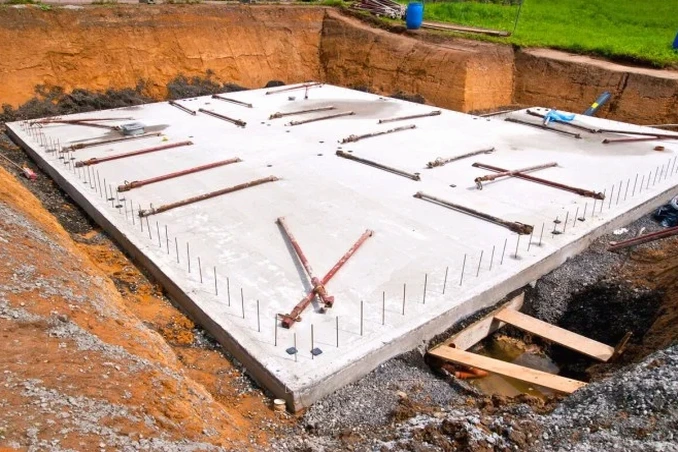
Cleveland’s footprint tells a story of rapid industrial expansion onto the lake plain, where the Cuyahoga River meets Lake Erie. Much of the downtown core and the Flats rest on glacially consolidated sediments and historic fill that can compress unevenly under structural loads. Spread footings often struggle in these conditions, which is why raft foundation design has become a recurring solution in our project pipeline across the city. Rather than fighting the soil column pier by pier, a stiffened mat slab bridges soft lenses, distributing column loads across the full footprint of the building. In Cleveland, where the contact between natural lacustrine clay and anthropogenic debris can shift within a single city block, we lean on this approach to keep total and differential settlement within IBC Chapter 18 tolerances. For sites where the upper fill is too erratic, we sometimes recommend a stone column ground improvement phase before finalizing the mat thickness, ensuring the bearing stratum responds uniformly under the design pressure.
In Cleveland's lakebed deposits, a properly designed raft doesn't just carry the structure — it bridges the erratic transition between natural clay and century-old fill, turning a variable subgrade into a predictable bearing platform.
Scope of work in Cleveland
Demonstration video
Typical technical challenges in Cleveland
A mid-rise residential project off Detroit Avenue in Cleveland taught us a hard lesson about ignoring buried stream channels. The geotechnical report had logged stiff clay at 3 meters, but during excavation for the raft, we exposed a lens of saturated organic silt — a relic of a pre-industrial creek that had been piped and filled in the 1890s. The original design assumed uniform bearing; that soft pocket threatened a differential settlement of nearly 40 millimeters under the tower block. We had to pause the pour, over-excavate the zone, and replace it with engineered granular fill compacted to 95 percent Modified Proctor before casting the mat. The incident reinforced a principle we now apply to every raft foundation design in Cleveland: never trust a single borehole in a city built on reworked land. We mandate a tighter grid of CPT soundings or test pits across the mat footprint, and when we find fill thickness varying by more than a meter, we run a sensitivity analysis on the spring constants to confirm the slab’s flexural capacity can absorb the irregularity without cracking.
Our services
Our Cleveland-focused raft foundation design services combine geotechnical investigation with structural modeling to deliver mat slabs that work with the local ground, not against it. Each scope includes a detailed assessment of the subgrade variability and a reinforcement scheme tailored to the architectural layout.
Geotechnical Investigation for Mat Foundations
We execute SPT borings and CPT soundings across the building footprint to map fill thickness, locate the top of competent glacial till, and measure groundwater elevation. Laboratory consolidation and triaxial tests on undisturbed Shelby tube samples provide the compressibility and strength parameters needed to calibrate the finite element model of the raft, ensuring the modulus of subgrade reaction reflects actual Cleveland stratigraphy rather than textbook defaults.
Structural Analysis and Reinforcement Design
Using the soil springs derived from the field and lab program, we model the mat as a flexible plate under column and wall loads, checking punching shear at concentrated supports and computing bending moments for both service and ultimate limit states. The output is a reinforcing plan with bar schedules, thickened sections at cores, and construction joint details that suit Cleveland's seasonal pour windows and the need for watertightness when the water table is within a meter of the slab underside.
Quick answers
When is a raft foundation a better choice than isolated footings in Cleveland?
Raft foundations become the preferred option when the allowable bearing pressure of the near-surface soil is below 150 kPa, or when the total area of isolated footings would cover more than 50 percent of the building footprint. In Cleveland, this situation is common in the Flats and near the Cuyahoga River, where granular fill overlies soft clay. A mat also handles erratic fill better — rather than designing each footing for a different spring constant, the raft bridges the soft spots and keeps differential settlement within tolerable limits for the superstructure.
What does a typical raft foundation design project cost in the Cleveland area?
For a standard commercial or mid-rise residential building in Cleveland, the combined geotechnical investigation and structural design of a raft foundation typically falls between US$1,150 and US$3,760. The final figure depends on the number of boreholes required, the complexity of the column layout, and whether ground improvement measures like stone columns are needed before the mat is cast. We provide a fixed-fee proposal after reviewing the architectural plans and any existing soil data for the site.
How does frost depth affect raft foundation design in Cleveland?
The Ohio Building Code prescribes a frost penetration depth of 42 inches for the Cleveland region. For a raft foundation, this means the bottom of the mat must bear at least 42 inches below finished grade unless the building is heated and the slab is protected from freezing by insulation or other thermal measures. In practice, we set the underside of the mud slab at or below that depth, and in unheated structures like parking garages, we add rigid foam board around the perimeter to prevent frost heave from lifting the edges of the mat unevenly.