Designing asphalt on the East Side versus the West Side of Cleveland means dealing with two very different soil histories. West Side neighborhoods often sit on dense glacial till left by the Wisconsin ice sheet, while parts of the East Side and the Flats have deep lacustrine clays deposited by ancient Lake Erie shorelines. These contrasts affect every pavement section we design. A subgrade that looks solid after compaction can lose half its strength after one freeze-thaw cycle if the fines content is too high. That is why our lab pairs standard Proctor tests with detailed grain-size curves before we even start the pavement structure calculation. For projects near the Cuyahoga River, where fill materials are unpredictable, we also run CPT testing to verify in-situ density without disturbing the layered silts and clays that complicate pavement design across Cleveland.
Cleveland's frost depth reaches 42 inches. A pavement section designed without a proper CBR curve on the clay subgrade will fail before the first winter ends.
Scope of work in Cleveland
Typical technical challenges in Cleveland
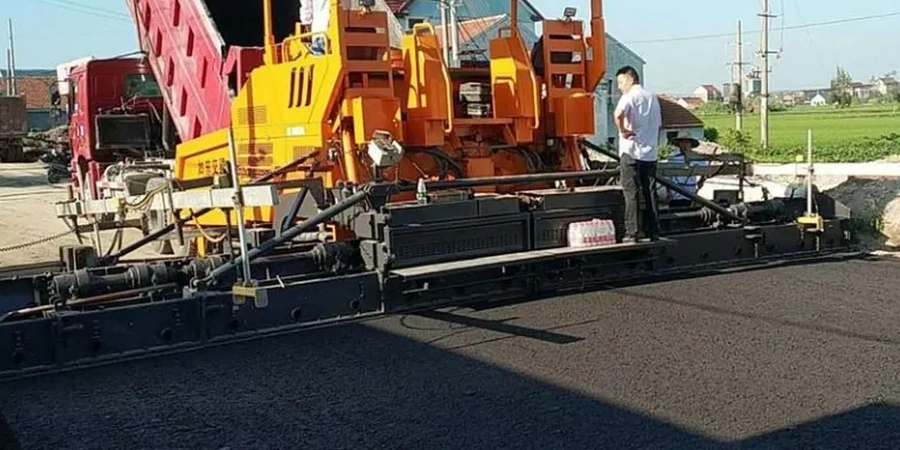
The pneumatic compactor and the nuclear density gauge are the first tools on site after the asphalt paver finishes a lift. We run density readings every 150 feet along the mat, then core the suspect spots where the gauge shows more than 2 percent air void deviation. On Cleveland's north-facing slopes, where winter moisture sits in the base course until April, a poorly compacted binder layer turns into a network of fatigue cracks by year three. The biggest risk we catch during design is under-specifying the base thickness over a CBR 3 clay, a value we see routinely in the Euclid Creek watershed. When the subgrade CBR drops below 5, we push the design toward a full-depth asphalt section or a geogrid-reinforced base. Without that, the pavement ruts before the first heavy truck season ends.
Our services
We provide two core packages for flexible pavement design in the Cleveland area. Each one is built around the specific distress mechanisms that shorten pavement life here: frost heave in silty subgrades, rutting from saturated clay bases, and alligator cracking where drainage is poor.
Subgrade Characterization for Asphalt Pavements
We test the top 3 feet of your subgrade. Resilient modulus estimation via CBR, coupled with Atterberg limits and Proctor curves. If the PI is above 15, we recommend a stabilization strategy, usually lime or cement, before placing the base course.
Pavement Structure & Material Verification
Once the section is designed, we verify every lift. That includes sand cone density on the subbase, nuclear gauge correlation on the asphalt binder course, and Marshall stability on the plant mix. We check gradation against ODOT Item 301 and 302 specs.
Quick answers
How much does a flexible pavement design package cost in Cleveland?
A full subgrade investigation plus pavement thickness design typically runs between US$1,500 and US$4,590, depending on the number of borings, lab tests required, and whether we need to model frost protection layers. A small parking lot with two borings sits on the lower end; an arterial road with multiple subgrade types and full ODOT documentation lands on the upper end.
Which lab tests are mandatory for an asphalt pavement section on Cleveland clay?
At minimum, we need a Proctor curve (ASTM D698) to establish maximum dry density, a soaked CBR test (ASTM D1883) to capture strength after saturation, and Atterberg limits (ASTM D4318) to assess frost susceptibility. If the plasticity index exceeds 15, we add a grain size analysis per ASTM D6913 to quantify the silt fraction that drives heave.
Do you follow ODOT or AASHTO pavement design methods?
We use the AASHTO 1993 Guide for structural number calculation, but we cross-check critical sections with the Mechanistic-Empirical Pavement Design Guide (MEPDG) when traffic loads are high. All material testing and compaction specs align with ODOT Construction and Material Specifications, particularly Items 301, 302, and 304 for base and asphalt layers.