The excavator bucket cuts through glacial till on the near west side. A Cleveland exploratory test pit opens the ground in under two hours, exposing layered stratigraphy from the surface down to eight or ten feet. Direct observation replaces inference. Our field crew logs each horizon using ASTM D2488 visual-manual procedures, photographs the sidewalls, and collects bulk samples where the soil changes character. In a city where lacustrine clays and beach ridges alternate block by block, seeing the profile with your own eyes resolves questions that borings alone cannot answer. We coordinate with OUPS for utility clearance before any machine breaks ground.
Seeing the soil in place resolves more questions in twenty minutes than a stack of lab reports resolves in a week.
Scope of work in Cleveland
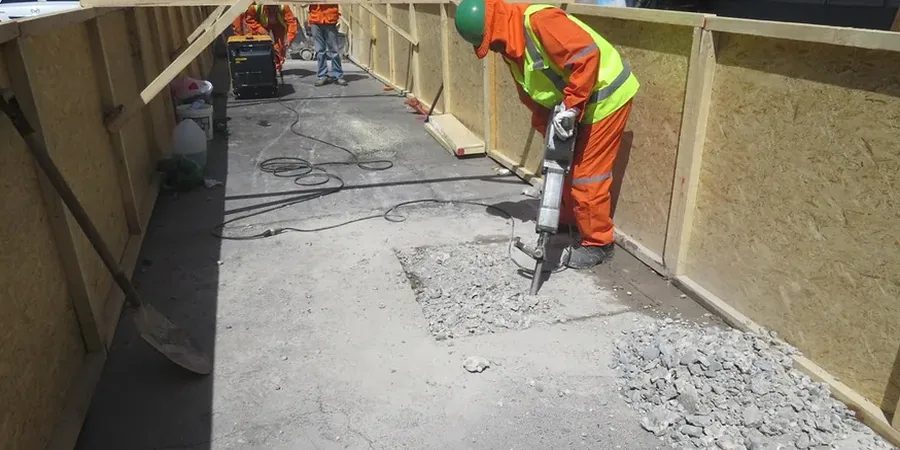
Typical technical challenges in Cleveland
Two Cleveland neighborhoods illustrate the risk of skipping a test pit. Ohio City sits on dense glacial till with high blow counts; a shallow footing performs well with minimal over-excavation. Tremont, just across the valley, often contains old demolition debris, brick fragments, and undocumented fill extending six or eight feet deep. A foundation designed for till will fail on that material. The test pit reveals the difference before concrete is poured. Other hazards include perched groundwater in sandy lenses, organics in former stream channels, and soft clay pockets that deflect a hand penetrometer with almost no resistance. No CPT truck in a parking lot can capture the spatial variability that an open excavation exposes across a 20-square-foot face.
Our services
Each test pit in Cleveland is configured to the site constraints and the questions the design team needs answered. We handle utility coordination, traffic control, and Ohio EPA notification for off-site disposal if contaminated material is suspected.
Standard Exploratory Test Pit
Open excavation to 14 ft with logged sidewalls, bulk sampling at each stratum change, and infiltration testing where stormwater management is required.
Pit Floor Sampling
Shelby tube or hand-carved block samples taken from the pit floor for laboratory strength and consolidation testing. Used when the target stratum is below the practical wall depth.
Urban Fill Investigation
Targeted pits in the Flats and near-downtown corridors to map debris layers, identify buried foundations, and collect environmental grab samples for Ohio EPA screening.
Quick answers
How much does an exploratory test pit cost in Cleveland?
A standard test pit in the Cleveland area runs between US$530 and US$740. The range covers a single excavation up to 14 feet deep with visual logging, photography, and bulk sampling. The final number depends on machine mobilization distance, whether a spotter or traffic control is required, and whether laboratory testing is added to the scope.
How deep can a test pit go in Ohio before shoring is required?
OSHA classifies most soils in Cuyahoga County as Type C, the lowest strength category. Any excavation deeper than 5 feet in Type C soil requires a protective system: sloping back at 1.5H:1V, a trench box, or an engineered shoring design. We never put personnel in an unshored pit deeper than 4 feet.
What information does a test pit provide that a boring does not?
A test pit exposes a continuous face of soil, so you see layering, fissures, cobble content, and fill contacts that a split-spoon sample misses. You can photograph the profile, measure infiltration directly, and take large bulk samples for Proctor or gradation testing. The trade-off is depth: test pits stop where groundwater or stability becomes an issue, typically 10 to 14 feet.
How long does utility clearance take in Cleveland?
Ohio law requires contacting OUPS at least 48 hours before digging, not counting weekends or legal holidays. Most member utilities mark within two business days. We factor this lead time into every test pit schedule and will not mobilize equipment until the site is cleared. More info.